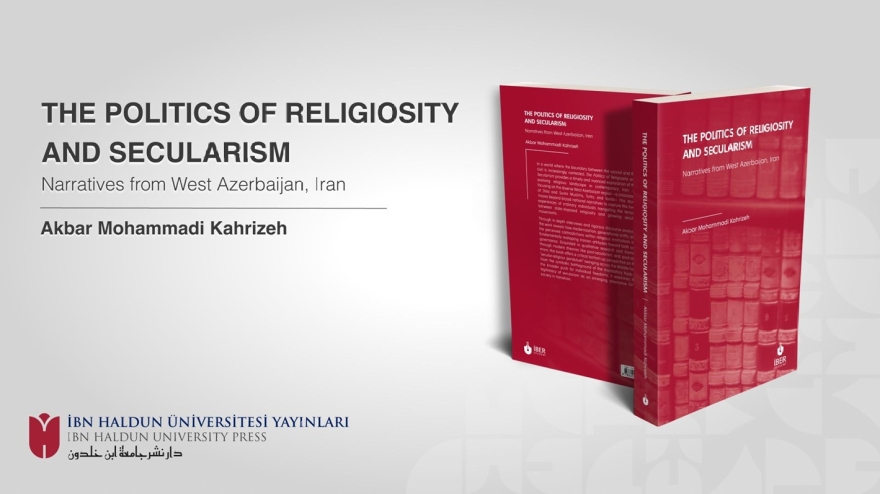
The Master's thesis of our graduate Rahime Seyit, titled “Archeology of De-Democratization: Mobilizing the Pharaonic Past in Post-2013 Counterrevolutionary Egypt,” was published as a book by Ibn Haldun University Iber Academy Publications in March 2026.
In a post-colonial country like Egypt, reclaiming ancient history and archaeology from colonial powers is essential, but the context in which this past is reclaimed is also crucial. This book critically examines how the ancient Egyptian past has been mobilized by the Egyptian military government after the 2013 intervention. It focuses on two key governmental projects: the reconstruction of Tahrir Square (2020) and the Pharaohs’ Golden Parade (2021).
The book illustrates how ancient Egyptian archaeology has been used to transform Tahrir Square into a depoliticized and de-democratized space, erasing revolutionary memory. It also shows how ancient Egyptian archaeology is mobilized alongside military symbols in the Pharaohs' Golden Parade to reinforce the narrative that the current government’s projects are a continuation of ancient Egyptian civilization.
The book is an interdisciplinary study that brings together sociology, history, and media studies, with a focus on the relationship between historical narrative production and power dynamics. Drawing on digital media sources (newspapers, government websites, social media) covering the period from 2010 to 2025, it contributes to fields such as political sociology, anthropology, urban sociology, and historical sociology.
The author invites researchers working on Egypt and broader post-colonial contexts to critically examine how ancient pasts and their archaeology are claimed, framed, and mobilized.
We congratulate our graduate on her work and wish her continued success.