
Prof. Ramazan Aras and Research Assistant Yunus Yeşil’s Co-Authored Article Published in the Book Studies from Theory to Fieldwork in the 100th Year of Anthropology

The article titled “Understanding Society Through Emotions: A General Introduction to the Anthropology of Emotion”, co-authored by Prof. Ramazan Aras and Research Assistant Yunus Yeşil from our university’s Department of Sociology, has been published in the book “Studies from Theory to Fieldwork in the 100th Year of Anthropology.”
The co-authored article “Understanding Society Through Emotions: A General Introduction to the Anthropology of Emotion” by Prof. Ramazan Aras and Research Assistant Yunus Yeşil of Ibn Haldun University’s Department of Sociology has been published in the volume “Studies from Theory to Fieldwork in the 100th Year of Anthropology” (Hece Publishing, Editor: Meryem Bulut, 2025). The article highlights the critical importance of emotions in contemporary social sciences and provides a theoretical and methodological introduction to the field.
A Call for an Interdisciplinary Approach Revealing How Emotions Are Shaped Through Cultural Practices
Prof. Ramazan Aras and Research Assistant Yunus Yeşil emphasize the difficulties in defining emotions and argue that, beyond their biological, psychological, and neurological dimensions, particular attention should be given to their culturally, structurally, and socially constructed multi-layered nature. In this framework, they note that efforts to understand social, cultural, political, and economic events through collective sentiments—such as fear, hatred, trust, and anger—offer a new analytical perspective.
The article highlights that thinking about emotions has a deep historical background extending to philosophical and religious texts, drawing attention to how emotional experiences have transformed across different civilizations and cultures. It emphasizes that in the history of the social sciences, interest in emotions began early particularly in anthropology; while classical sociologists used emotions as tools to explain their grand theories, early anthropologists treated emotions as an integral part of cultural practices.
Finally, the article notes that with the rise of socio-cultural approaches from the 1970s onward, emotion studies became institutionalized, underscoring the methodological significance of ethnography in understanding emotions. Through examples such as Hochschild’s concept of emotional labor, Rosaldo and Lutz’s fieldwork, and Behar’s “vulnerable observer” approach, the study demonstrates how emotions are shaped through cultural and social practices. Concluding with the assertion that emotions must be examined through an interdisciplinary lens, the article offers a valuable contribution to the field.
We congratulate our academics and wish them continued success.
Related Content

Our Sociology Alumni Accepted into Master’s Programs at Prestigious National and International Universities

Our PhD Student Akbar Mohammadi Kahrizeh’s Thesis Titled “The Politics of Religiosity and Secularism” Published as a Book

Ayesha Syed Becomes PhD Defending Her Dissertation “(De)Constructing Pakistaniyat: A Saga of Dissemination of Master and Counter Narratives” Successfully

Our Visiting Faculty Member Prof. Mücahit Bilici’s Article Published in Vienna Yearbook of Kurdish Studies

Our PhD Candidate Neveen Fathi Abouldahab Presented Her Research at International Academic Events

Dr. Yasemin Özer Presented Her Research on Care Poverty and Care Inequalities at EASA 2026

Article Co-Authored by Our PhD Graduate and Visiting Researcher Dr. Dalal Bajes Published in the Q1 Indexed Journal of Palestine Studies
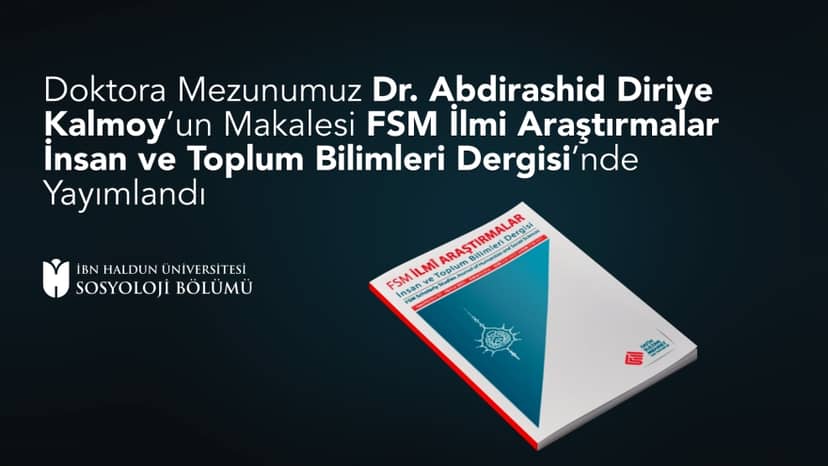
Article by Our PhD Graduate Dr. Abdirashid Diriye Kalmoy Published in FSM Scholarly Studies Journal of Humanities and Social Sciences
