
Assist. Prof. İbrahim Emre Yanık’s Article Published in the Journal of Justice, Opportunities, and Rehabilitation

An article by Assist. Prof. İbrahim Emre Yanık, a faculty member in the Department of Sociology at our University, titled “Community as Sanctuary: Reentry Experiences of Formerly Incarcerated Muslims”, has been published in a Q2-ranked international journal.
The article titled “Community as Sanctuary: Reentry Experiences of Formerly Incarcerated Muslims” by Assist. Prof. İbrahim Emre Yanık, a faculty member of the Department of Sociology at Ibn Haldun University, was published on December 10, 2025, in the Q2-ranked Journal of Justice, Opportunities, and Rehabilitation. This ethnographic study offers an in-depth examination of the experiences of formerly incarcerated Muslims returning to a small city in upstate New York.
It highlights their complex journey of navigating profound habitus shifts, the persistence of disciplinary behaviors shaped by prison life, and the welcoming support offered by local faith communities. Drawing on six months of participant observation and interviews with Imams, chaplains, and congregants at a local masjid, the research identifies four core themes. First, chaplains serve as crucial “liminal figures,” bridging the highly structured prison life and less regulated community contexts. Second, while institutional routines like “count time” reflexes persist, they represent a starting point from which new habits are formed. Third, the shift from carceral routines to unstructured social environments presents an opportunity for growth and adaptation, which is robustly supported by the faith community. Finally, Imams and the mosque community play a pivotal role in this transition, providing spiritual guidance, practical resources, and a powerful sense of belonging that fosters successful reintegration.
Integrating multiple theoretical frameworks, this study underscores the promise of holistic, culturally sensitive reentry initiatives that empower returning citizens by addressing both material needs and the profound psychological journey of post-incarceration life.
We congratulate our faculty member and wish him continued success.
Related Content

Our Sociology Alumni Accepted into Master’s Programs at Prestigious National and International Universities

Our PhD Student Akbar Mohammadi Kahrizeh’s Thesis Titled “The Politics of Religiosity and Secularism” Published as a Book

Ayesha Syed Becomes PhD Defending Her Dissertation “(De)Constructing Pakistaniyat: A Saga of Dissemination of Master and Counter Narratives” Successfully

Our Visiting Faculty Member Prof. Mücahit Bilici’s Article Published in Vienna Yearbook of Kurdish Studies

Our PhD Candidate Neveen Fathi Abouldahab Presented Her Research at International Academic Events

Dr. Yasemin Özer Presented Her Research on Care Poverty and Care Inequalities at EASA 2026

Article Co-Authored by Our PhD Graduate and Visiting Researcher Dr. Dalal Bajes Published in the Q1 Indexed Journal of Palestine Studies
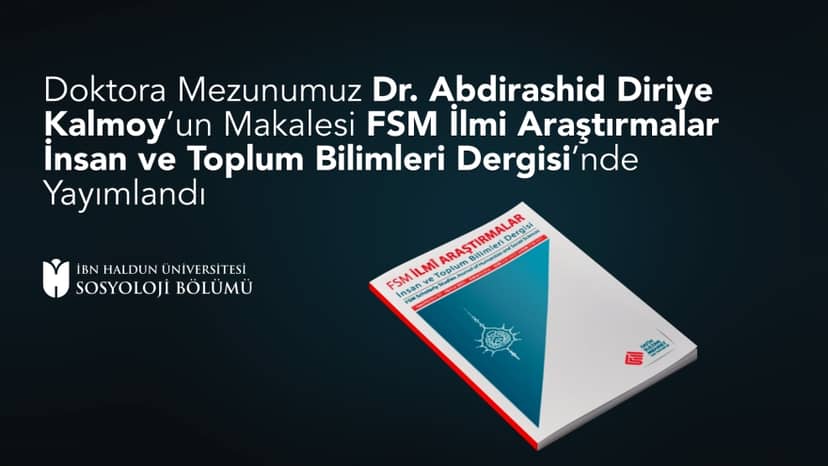
Article by Our PhD Graduate Dr. Abdirashid Diriye Kalmoy Published in FSM Scholarly Studies Journal of Humanities and Social Sciences
